

Overview:
- The Asia-Pacific (APAC) region is experiencing rapid infrastructure growth and high investment, creating strong demand for construction manpower.
- APAC countries are investing heavily in transportation, digitalization, and renewable energy projects.
- HR and procurement teams play a key role in workforce planning, compliance, deployment, and retention to meet project timelines.
- Contractors often rely on recruitment agencies for qualified migrant workers and legal processing.
- Partnering with a reputable recruitment agency can help companies secure skilled Filipino workers for their projects.
Deploying Skilled Filipino Construction Workers in APAC Infrastructure Projects
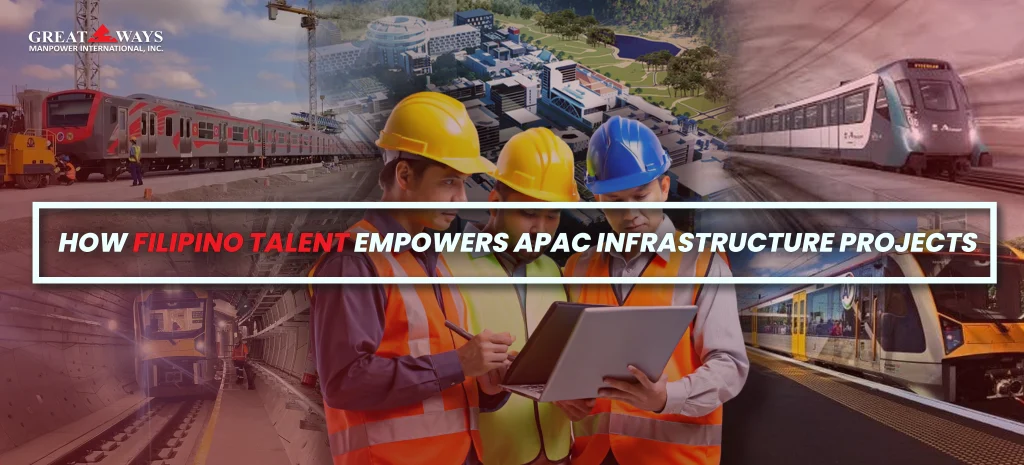
The Asia-Pacific (APAC) region, driven by rapid urbanization and economic growth, has invested heavily in infrastructure projects. As developing economies alone put up at least US$881 billion annually, it is expected that HR managers and procurement managers are vital in bringing these projects to reality.
Like the Saudi Vision 2030 roadmap, finding the right construction manpower is critical for HR managers and procurement teams to meet project deadlines, spend within budget, and minimize potential losses.

TABLE OF CONTENTS
Why does the APAC region invest in infrastructure?
Mega-Infrastructure Projects in Asia-Pacific
- Sydney Metro in Australia
- Chūō Shinkansen in Japan
- Songdo International Business District in South Korea
- City Rail Link (CRL) in New Zealand
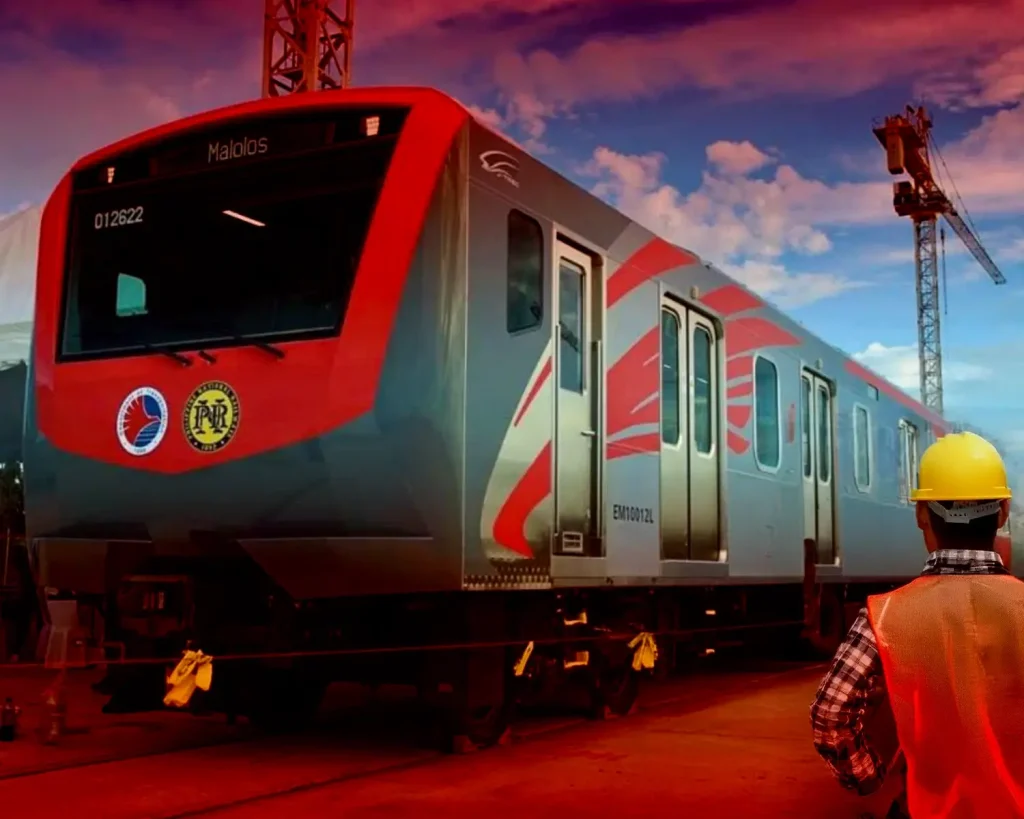
- North-South Commuter Railway in the Philippines
Importance of HR and Procurement Teams
Key Driver of Infrastructure Projects in APAC
The Asia-Pacific (APAC) region is heavily driven by economic development in areas such as sustainable energy sources, digitalization, and enhanced transportation systems. According to the Asia Development Bank, APAC countries need a total estimated investment of $1.7 trillion per year up to 2030.
Like the Saudi Vision 2030 roadmap, finding the right construction workforce will be critical for HR managers and procurement teams to meet project deadlines, spend within the allotted budget, and minimize losses.
Focus Areas in APAC: 3 Growth Engines Driving APAC Infrastructure
Different countries have different landscapes. In order to support trade and urbanization, investment in different modes of transportation, such as roads, railways, and airports, is a must.
Driven by AI, cloud computing, and IoT, the demand for improved digital infrastructure has never been higher. Capacity of data centers in the region is expected to grow 2.5 times until 2030.
In order to achieve net-zero by the year 2050, infrastructure projects in APAC are ramping up. The hunt for alternative energy sources continues, such as solar, wind, and emerging Waste-to-Energy (WTE) projects.
Related Blog You May Find Useful:
List of Notable Infrastructure Projects in APAC
As mega-construction projects emerge across the region, labor shortages occur. That’s why most of these countries have opened opportunities for skilled migrant construction workers and to help meet the region’s growing demand for construction manpower.

Sydney Metro (Australia)
Currently Australia’s largest, fully automated transport network. It is a railway expansion project from previously operating Metro North West & City & Southwest lines (M1) targeting 46 stations and 113 km of track.

Chūō Shinkansen (Japan)
A magnetic levitation (maglev) train line connecting Tokyo and Nagoya, with plans for extension to Osaka. Aiming to be the world’s fastest bullet train, it will reach Osaka from Tokyo in 67 minutes, reducing the travel time by more than an hour vs. Tokaido Shinkansen
Related Blog You May Find Useful:

Jeollanam-do AI Infrastructure (South Korea)
The project aims to be the world’s largest data center by 2030. This AI Supercluster Hub offers a vast area of land, an abundant power and water supply, a skilled workforce, and strong renewable energy potential.

Jeollanam-do AI Infrastructure (South Korea)
The project aims to be the world’s largest data center by 2030. This AI Supercluster Hub offers a vast area of land, an abundant power and water supply, a skilled workforce, and strong renewable energy potential.
Related Blog You May Find Useful:
City Rail Link (New Zealand)
A railway project in the nation’s capital, Auckland, connecting the city’s entire rail network. This also serves as a rehabilitation program of old railways and platforms eyeing to be opened early 2026.

GREAT WAYS MANPOWER DEPLOYS FILIPINO CONSTRUCTION WORKERS ABROAD
At Great Ways, we assist companies like yours for stress-free manpower deployment abroad. From navigating different labor laws to hiring qualified candidates, we will be with you every step of the way!
The Role of HR and Procurement Teams
Wide-scale infrastructure projects will never run out of manpower requests until they are finished. This is why HR managers’ role is critical in the deployment of a skilled construction workforce and aligning them with the project’s timelines.
Usually a strategic initiative, contractors rely on manpower agencies to secure qualified migrant workers to ensure continuity of work.
This also ensures the proper and legal deployment of migrant construction workers and helps HR managers focus on other important aspects of their job.
Filipino Construction Manpower might be what you need
Filipino professionals in construction are preferred by most HR managers worldwide compared to other migrant workers. This is due to innate traits such as:
Technical Expertise
The Philippines has a strong focus on technical and vocational education, producing highly qualified construction workers.
Hard Work and Resilience
Filipino workers are known for their dedication and the ability to work under pressure.
English Proficiency
Filipinos can communicate effectively on international worksites because English is one of the official languages in the country.
Adaptability
The Filipino people are known to be hospitable and respectful, allowing them to integrate easily into diverse work environments.
Global Experience
Filipino architects and engineers have played significant roles in iconic, complex projects worldwide, such as the Burj Khalifa, the Dubai Metro, and many more.
Conclusion
Infrastructure Projects in Asia-Pacific (APAC) help in moving the countries involved forward. Once these projects are completed, it will help ease the lives of the nation’s citizens. To help you in these projects, Great Ways Manpower International assists in deploying skilled Filipino construction manpower whenever you need it.
We believe that international partnerships like this benefit everyone.
Employers obtain the right kind of workforce. Workers get the chance to gain experience and provide for their families. And companies like yours contribute to the growing economy of your beloved country.
Whether you work in procurement or HR, if you want to explore the deployment of skilled Filipino workers to your project, collaborate with a reputable recruitment agency that will help you every step of the way.
Partner with Great Ways Manpower International Inc., and let’s make your dream project a reality.
REFERENCES:
Organisation for Economic Co-operation and Development. (2024). Addressing labour and skills shortages in a fast-changing economy. OECD Publishing.
https://www.oecd.org/content/dam/oecd/en/publications/reports/2024/07/addressing-labour-and-skills-shortages-in-a-fast-changing-economy_0b6482dd/757311cb-en.pdf
Equity Edge Research. (n.d.). Industry report: Construction industry. Substack.
https://equityedgeresearch.substack.com/p/industry-report-construction-industry
Hong Kong Trade Development Council. (n.d.). Meeting Asia’s infrastructure needs.
https://beltandroad.hktdc.com/en/insights/meeting-asias-infrastructure-needs

 English
 日本語
日本語 Polski
 العربية